• The Joy Portfolio: Investing in Activities That Compound Happiness

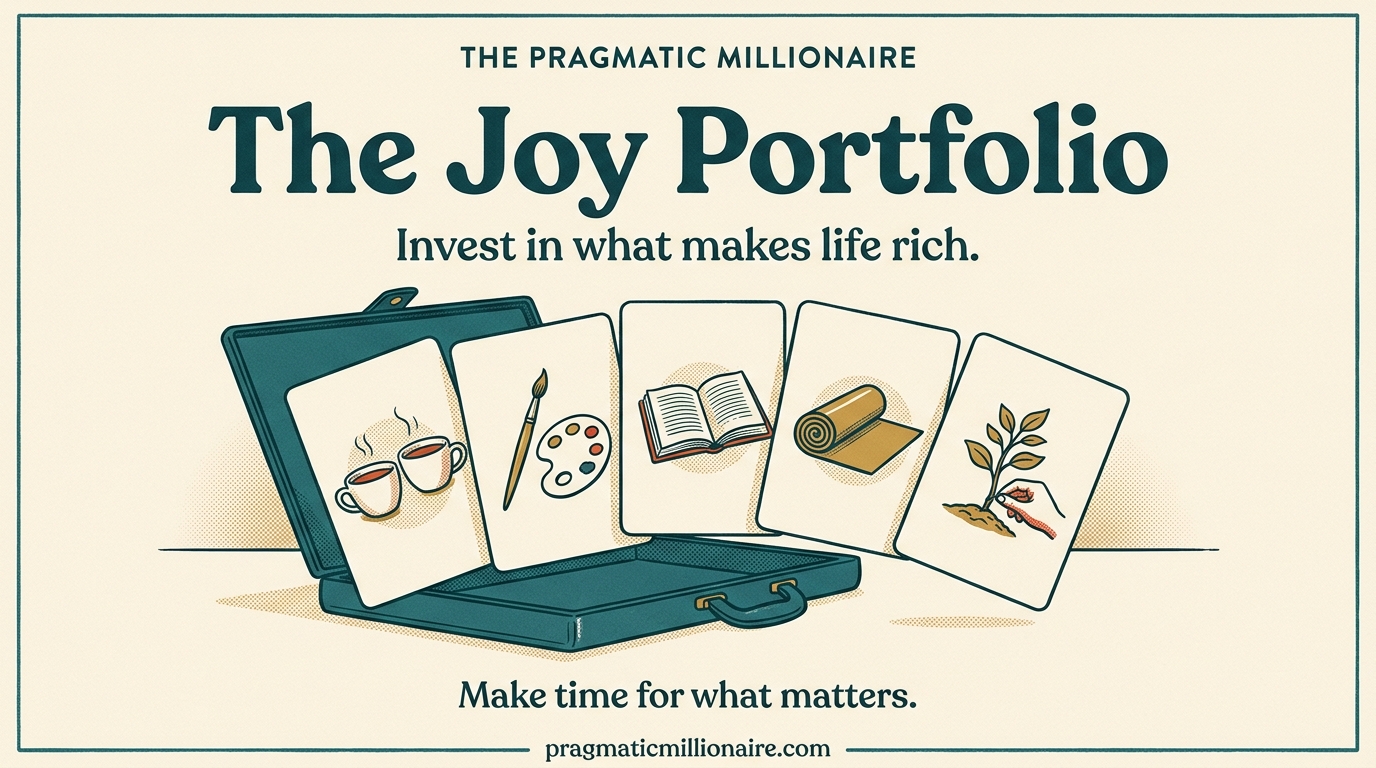
    Money isn’t the only way to build wealth. Time, energy, and experiences compound too. Just like a financial portfolio, the way you invest in your life determines your long-term happiness, health, and fulfillment. By practicing intentional living and focusing on lifestyle design, you can create a life that truly matters. Welcome to your Joy Portfolio.


    Why Your Time is Your Most Valuable Asset
    Life is finite—about 4,000 weeks on average. Every choice carries an opportunity cost. Saying yes to one activity often means saying no to another. Early retirement and time wealth are not just about money—they’re about reclaiming your most valuable asset: time.

    Intentional living means:

    • Recognizing what truly matters.
    • Accepting limits rather than trying to do everything.
    • Focusing on high-value joy assets that compound happiness over time.

    Building a Joy Portfolio: What to Invest In
    A Joy Portfolio is made up of “assets” that grow your well-being over time:

    • Relationships: Friends, family, mentors, and romantic connections.
    • Hobbies: Activities that spark flow and creativity, from dancing to painting.
    • Learning: Skills, languages, and knowledge that expand your mind.
    • Health Practices: Exercise, yoga, meditation, and nutrition.
    • Meaningful Work: Tasks that align with your values, even if small.

    Like financial assets, these need deliberate allocation. Random or inconsistent efforts won’t yield compounding happiness or long-term fulfillment.


    Compounding Happiness Through Daily Habits
    Small, consistent investments in your Joy Portfolio create long-term gains:

    • A weekly dance class improves fitness, mood, and social connection.
    • Spending 30 minutes daily learning a language grows skill and confidence.
    • Investing in friendships with regular meetups strengthens emotional support networks.

    These activities multiply in value, just like compound interest in a financial account. Lifestyle design and structured routines help ensure your daily actions align with your values.


    Rebalance Your Life for Maximum Fulfillment

    1. Track Your Activities: Note what makes you feel energized, satisfied, or happy.
    2. Schedule Joy: Treat high-value activities as non-negotiable appointments.
    3. Review and Rebalance: Periodically assess your portfolio. Shift time from low-return activities to high-return ones.
    4. Start Small: Even 10–20 minutes daily in a joy asset compounds over months and years.

    By prioritizing what truly matters, you create time wealth and ensure your life aligns with your vision for early retirement and intentional living.


    Conclusion
    Wealth isn’t only money. Time and experiences are equally valuable assets. By intentionally investing in your Joy Portfolio, you can maximize happiness, fulfillment, and purpose.

    Call-to-Action:
    Start designing your Joy Portfolio today. What three activities will you invest in this week that will grow your long-term happiness and help you live intentionally?

    Stay the course.

    — The Pragmatic Millionaire


    References & Further Reading:
  • How I Grew My Stock Portfolio 28% YTD Without Timing the Market (Oct 2025 Update)

    📈 My Year-to-Date Results

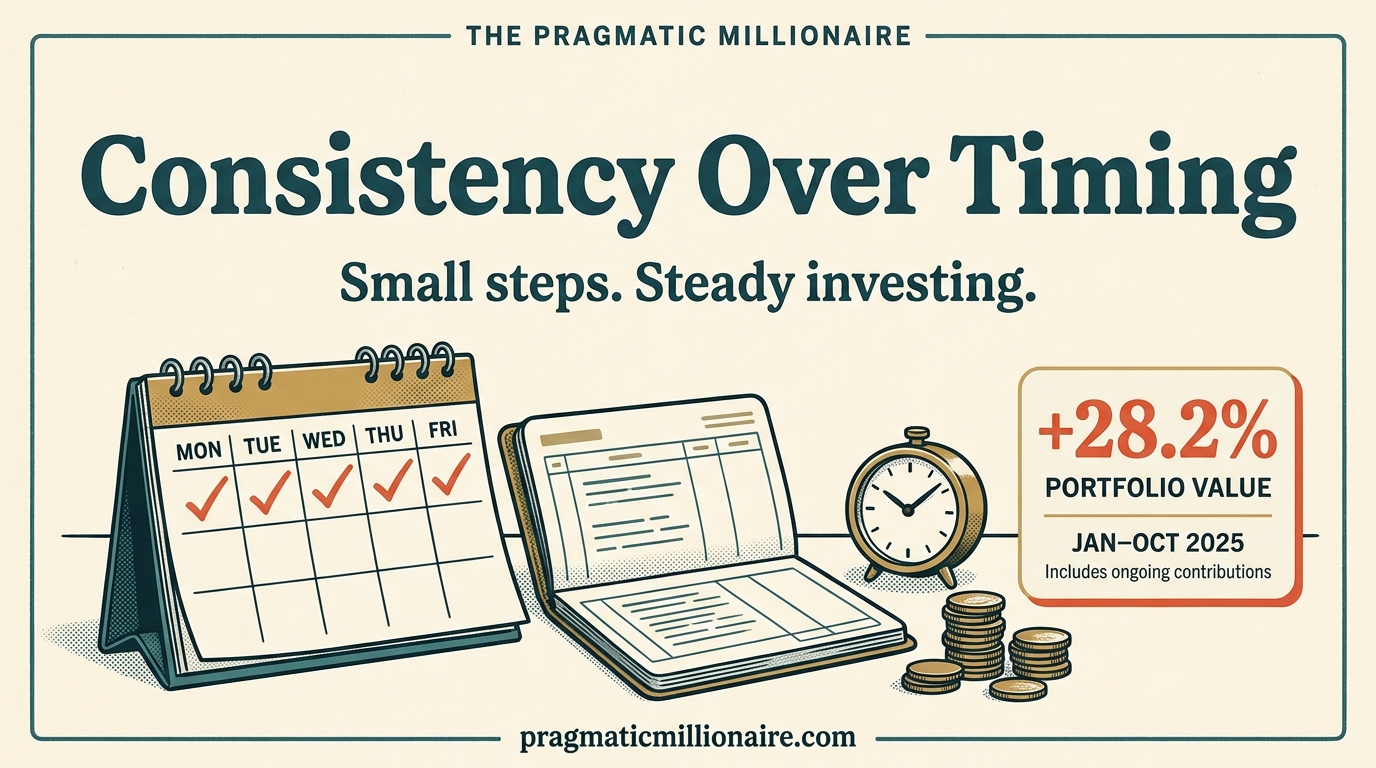
    In January, my stock portfolio was $566,657
    By end of October, it reached $726,493 — a +28.2% gain

    All this happened without timing the market.
    My approach? Automated daily investing (Mon–Fri) using a dollar-cost averaging (DCA) system.


    💡 Why I Chose Daily DCA

    Instead of guessing market highs or lows, I invest a fixed amount automatically each weekday.
    This turns investing into a routine rather than a decision.

    Daily automation via Wealthsimple:

    • Removes emotion and hesitation
    • Captures both up and down days
    • Smooths volatility
    • Keeps money working immediately

    📊 What the Data Shows

    Month EndPortfolio Value% Change vs January
    January$566,657–
    April$495,794–12.5%
    May$553,765-0.23%
    October$726,493+28.2%
    • The portfolio dropped early (Jan → Apr) but rebounded fast.
    • Average monthly gain since May ≈ 3.3%.
    • Compound monthly growth rate ≈ 2.1%, annualized ≈ 28%.

    🧠 Key Takeaways

    • Consistency > Timing: The compounding effect beats guessing entry points.
    • Automation removes emotion: Investing runs without interference.
    • Track progress: Monthly tracking shows how patience pays off.
    • Diversify wisely: Automation only works if the base is diversified.
    • Expect dips: The April drawdown tested patience but paid off later.

    🔍 Why This Works

    Daily DCA keeps you invested. It avoids two big mistakes:

    1. Missing market upside while waiting for “the right time.”
    2. Going all-in at the wrong time.

    It’s not about perfection — it’s about exposure and habit.
    If you have steady income, frequent small investments are powerful.


    ⚠️ A Few Caveats

    • Lump-sum investing can outperform when markets trend strongly upward.
    • Frequent investing requires zero-fee platforms like Wealthsimple or Questrade to avoid erosion.
    • Automation ≠ neglect — rebalance periodically to stay aligned with goals.

    ✅ The Bottom Line

    If you want real, sustainable progress:

    Invest consistently, automate the process, and stop timing the market.
    Small, daily steps compound faster than dramatic bets.

    Stay the course.

    — The Pragmatic Millionaire


    🔗 Further Reading

    1. I Will Teach You To Be Rich – Dollar Cost Averaging vs Lump Sum
    2. Personal Finance Club – Lump Sum vs Dollar-Cost Averaging
    3. Canadian Couch Potato – Does Dollar-Cost Averaging Work?
    4. The Poor Swiss – Dollar-Cost Averaging Is More Risky Than You Think
    5. Barb Friedberg – How to Buy Low and Sell High with DCA
  • Health Is Wealth: Why Your Body Is the Ultimate Asset in Early Retirement

    Discover why maintaining your physical and mental health is essential to achieving true early retirement freedom.


    Health Is Wealth: Why Your Body Is the Ultimate Asset in Early Retirement

    The path to early retirement often starts with spreadsheets, compound interest, and index funds. But here’s the truth that many in the FIRE (Financial Independence, Retire Early) community learn too late — financial freedom without physical health is a hollow victory.

    You can save, invest, and plan for decades, but if your energy, strength, and cognitive sharpness are gone, what exactly are you retiring to? Health is not just another life goal. It’s the engine that makes financial independence meaningful.


    Healthspan Over Lifespan

    In Outlive: The Science and Art of Longevity, Dr. Peter Attia reframes longevity as more than just extending years. The goal is to extend your healthspan — the number of years you remain strong, capable, and mentally sharp.

    He introduces the idea of the Centenarian Decathlon — identifying key physical tasks you want to perform in your later decades (like hiking, carrying groceries, or playing with grandkids) — and training now to preserve those abilities.

    This approach mirrors how we think about financial planning. Just as you invest today for future income, you train today for future vitality. Muscle mass, balance, cardiovascular fitness, and flexibility are your body’s compound interest.


    Optimizing Health Like an Investment

    Tim Ferriss’s The 4-Hour Body made biohacking mainstream. His central idea is simple: treat your body like a data-driven experiment.

    Ferriss’s methods — from slow-carb eating to quantified self-tracking — may not all apply to everyone, but his mindset is gold: measure, iterate, and optimize. If you can track your net worth, you can track your sleep, recovery, and metabolic health.

    Health metrics like resting heart rate, VO₂ max, body fat percentage, and sleep efficiency are no different from ROI, CAGR, or asset allocation — they reflect how well your system performs over time.

    Consistency and data-driven iteration create long-term results — both in your portfolio and in your physiology.


    The Neuroscience of Longevity

    Dr. Andrew Huberman, through his Huberman Lab Podcast, translates neuroscience into daily health optimization strategies.

    Huberman emphasizes the role of the nervous system in stress management, motivation, and recovery. His evidence-based routines — like morning sunlight exposure to regulate circadian rhythms, controlled cold exposure to improve resilience, and breathwork to reduce anxiety — help maintain both mental and physical performance.

    His approach aligns perfectly with the FIRE philosophy: consistency, discipline, and systems thinking. You wouldn’t YOLO your investments — don’t YOLO your biology either.


    Health as the Core Asset Class

    Think of health as your most valuable investment class. Each workout, healthy meal, and good night’s sleep is a deposit into your energy account. Over time, those deposits compound into a higher “return on life.”

    Poor health, on the other hand, acts like an invisible tax — draining energy, productivity, and joy. Chronic stress, fatigue, or preventable illness quietly erode your freedom far faster than inflation ever could.

    Your health portfolio deserves the same structure as your financial one:

    • Diversify: Strength, cardio, mobility, nutrition, recovery.
    • Automate: Build habits that run without constant willpower.
    • Reinvest dividends: Let each gain (better sleep, more energy) fuel new habits.

    My Health-FI Formula

    After years of chasing productivity, I realized the real metric of success wasn’t hours worked — it was energy available.

    So I rewired my focus:

    • Prioritize sleep over screen time.
    • Maximizing whole foods, minimizing processed foods
    • Eliminating alcohol
    • Lift weights and train for longevity, not aesthetics.
    • Activate my mornings by cycling to work.
    • Practice yoga and breathwork to stay grounded.

    These simple, repeatable actions now form the foundation of my “Health-FI” strategy — the pursuit of health freedom alongside financial freedom.


    The Future You’re Building

    Imagine reaching financial independence with the energy to travel, dance, explore, and build new projects — not just to rest. The future version of you deserves a body that can cash the checks your bank account writes.

    Early retirement is about more than escaping work. It’s about designing a life that feels good to live. And that requires investing in the asset that compounds fastest — your health.

    So as you automate your investments, automate your recovery, sleep, and training too. Because in the long run, health is not just wealth — it’s the currency that makes all wealth matter.

    Stay the course.

    — The Pragmatic Millionaire

  • ChatGPT says I can retire in 4.9 years

    Current portfolio value: CAD $785,160.64
    Target portfolio value to FIRE: CAD $1,500,000
    Target annual withdrawal rate in retirement: $60,000 (4%)

    However, it’s important to include inflation in the calculation, to maintain purchasing power.